Thinking about building in Avellanas because you want a home that feels truly your own? It is an exciting idea, but in this part of Santa Cruz, the right lot matters just as much as the right floor plan. If you understand zoning, access, utilities, and approvals before you buy, you can move forward with much more confidence. Let’s dive in.
Why lot selection comes first
In Avellanas, a custom build usually starts with the parcel, not the house design. The area falls under the Plan Regulador Integral Avellanas-Junquillal, which sets the rules for how land can be used and what may be built in specific subzones.
That matters because one lot may be suitable for a straightforward residential project, while another may carry added restrictions tied to tourism use, mixed use, environmental protection, drainage, or access. In practical terms, your first question should be whether the parcel supports your intended use.
Understand the zoning path
The Avellanas-Junquillal plan is divided into different subzones, including protection areas, tourism-oriented areas, mixed-use areas, and access or viality areas. Each of these categories can carry different limits on use, lot size, density, height, and design.
For example, some tourism zones require an ICT tourism declaratoria. Some mixed zones may allow a single residence for the concessionaire and family, but only within specific limits. If you are planning a private home, you want to confirm early that the zoning matches that goal.
Beach-adjacent lots follow different rules
If a parcel is inside the Zona Marítimo Terrestre, the legal path changes. Costa Rica treats the first 50 meters from the ordinary high-water line as the public zone and the next 150 meters as the restricted zone.
That means a beach-adjacent property may involve a concession structure rather than a standard inland fee-simple ownership path. If you are comparing multiple lots in Avellanas, this is one of the most important distinctions to clarify at the start.
What to verify before buying land
Before closing on a lot, you should confirm the parcel’s cadastral plan, use of soil, and access conditions. The Municipality of Santa Cruz provides forms for construction permits, minimum permit requirements, use-of-soil requests, stormwater discharge, earth movement, and ZMT concession procedures.
That local paperwork points to a clear reality: building approval in Avellanas is document-heavy and parcel-specific. A lot that looks simple in a listing may still need extra verification before it becomes build-ready.
Check legal access early
Access can be a hidden issue. The coastal plan includes access and viality zones, and CFIA requirements show that road or municipal street alignment may be required depending on the property.
In other words, a beautiful lot is not enough on its own. You also want clean legal access and clear road frontage, because those details can affect both permit timing and buildability.
Confirm water availability
Water is one of the biggest variables from lot to lot. CFIA requires formal proof of water availability as part of the build file.
AyA’s current Chorotega coverage information also notes that the Acueducto Costero de Santa Cruz sells water in block to operators rather than through one single pipe-linked coverage area. For you, that means water access should never be assumed just because another property nearby has service.
Review power options
Electric service is available through a local utility, but connection conditions can still vary. Coopeguanacaste serves a large area on the Nicoya Peninsula and reported renovation work on the Avellanas electrical circuit from Hacienda Pinilla to Paraíso.
Even so, some homes located more than 1.5 kilometers from the grid may require alternate solutions instead of a standard public-service connection. This makes utility due diligence especially important for larger land parcels or more secluded homesites.
Ask about drainage and site conditions
The Avellanas plan also highlights groundwater vulnerability, drainage controls, and conservation concerns. Some areas have hydrogeological or natural-hazard limits that may affect how the site is engineered.
That can influence project cost and complexity. A lot with strong location appeal may still require more detailed work for drainage, wastewater handling, or geotechnical study than you expected.
The permit process in practical terms
For most buyers, the approval path is easier to understand as a sequence rather than a single permit. A typical project moves through due diligence, concept design, utility confirmation, environmental screening if required, municipal review, site preparation, and then construction.
This is one reason why early planning matters so much. The official review steps alone can take weeks, even before grading or foundation work begins.
Work with licensed professionals early
CFIA’s APC workflow is built around a professional project file and related contract steps, so a local architect or engineer should be involved early. The project file typically needs a Ministry of Health declaration, water availability, wastewater disposition, and the cadastral plan.
Depending on the parcel, it may also require road alignment, airport-influence alignment, watercourse alignment, spring-protection alignment, ICE high-voltage alignment, or restricted-access authorization. The exact list depends on the site, which is why lot-specific review is so important.
Municipal review is a real process
In Santa Cruz, the municipality handles construction-related requests directly, including permits, minimum requirements, use of soil, and ZMT concession forms. This is not a one-size-fits-all national process.
Your file usually moves only after it is complete and the required payments and insurance documents are in place. Incomplete submissions can slow the schedule quickly.
Environmental review may be required
For standard inland projects, SETENA review is separate from the municipal permit. Some small projects under 500 square meters and certain minor works can be exempt if they are not in environmentally fragile areas, but other projects do require environmental review.
This is especially important in Avellanas, where the local plan includes environmental sensitivity and makes clear that the plan itself does not replace SETENA licensing. Even when environmental review is not the longest step, it can still shape your timeline.
Coastal concession properties are more layered
If the lot is in the ZMT, the process becomes more complex. The ICT reviews the technical component of the concession file sent by the coastal municipality so it can issue institutional endorsement before registration in the Public Registry.
For buyers, the takeaway is simple: a coastal concession property should not be treated like a standard inland lot. It follows a more layered legal and administrative path.
What affects your timeline most
In Avellanas, the smoothest projects are usually the ones with clear zoning, legal access, confirmed water, workable power access, and no major ZMT or environmental complications. When those pieces line up early, the process tends to move with fewer surprises.
The slower projects are usually the ones where one or more of those issues remain unresolved. That is why careful lot selection often saves more time than trying to rush the permit stage.
Site preparation can shape the budget
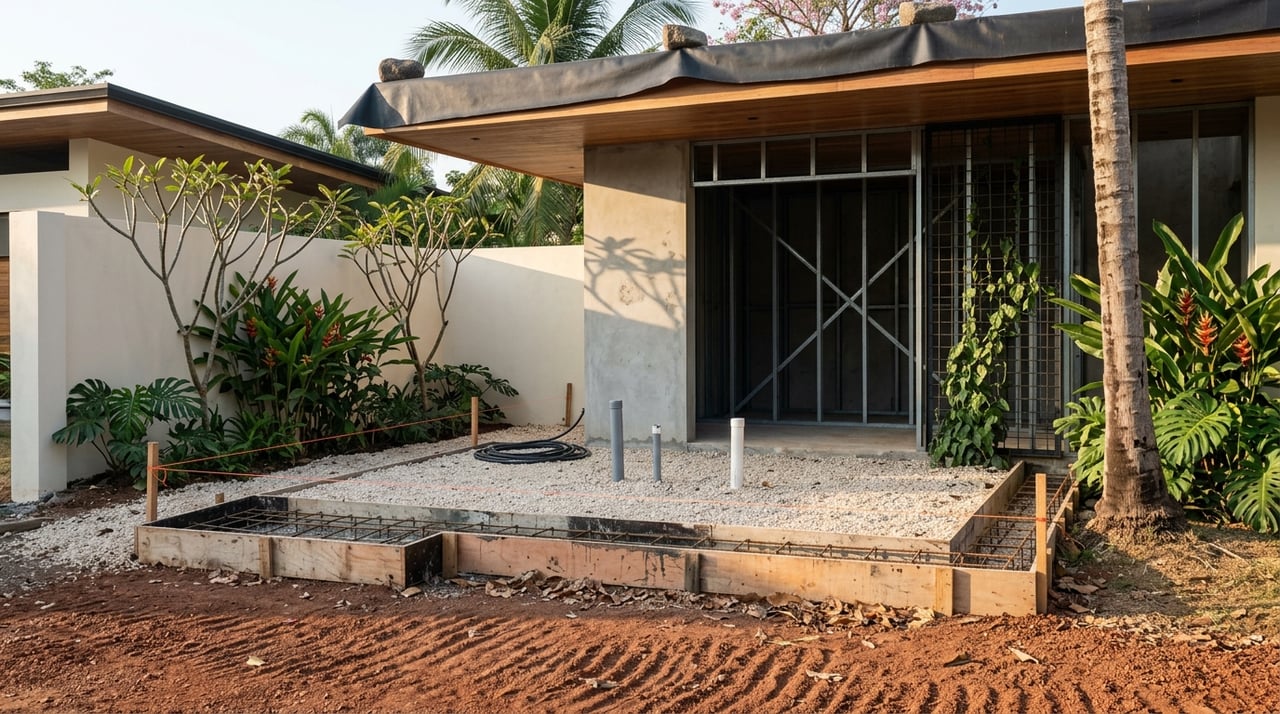
Site work in Avellanas can be more involved than in a typical subdivision. The local plan calls for geotechnical studies, seismic-code compliance, pluvial management that reduces erosion, reforestation with native species, and in some areas, wastewater systems that are not conventional septic tanks unless additional technical support is provided.
That means the land itself can shape the build strategy. A tropical-modern home may look elegant on paper, but the final approach still has to respond to the lot’s zoning, drainage, soils, and infrastructure realities.
A smart way to approach your build
If you are dreaming about building in Avellanas, it helps to think like a planner before you think like a designer. Start by confirming the legal framework of the parcel, then review utilities, access, environmental requirements, and site conditions.
From there, your architect, engineer, and real estate advisor can help you align the vision with what the property actually supports. That is often the difference between a smooth, well-curated project and a costly learning curve.
If you are exploring land or custom home opportunities in Avellanas and want local guidance grounded in the realities of Santa Cruz, connect with Dawn Wolfe for a more informed next step.
FAQs
What should you check before buying land in Avellanas?
- You should confirm zoning, cadastral plan, use of soil, legal access, water availability, power connection conditions, and any drainage, wastewater, or environmental constraints tied to the parcel.
How does zoning affect a custom home in Avellanas?
- Zoning under the Plan Regulador Integral Avellanas-Junquillal can limit use, density, height, lot size, and design, so the parcel must support your intended residential project.
What is different about building on a beach-adjacent lot in Avellanas?
- A lot inside the Zona Marítimo Terrestre may follow a concession path instead of a standard inland fee-simple path, which adds legal and administrative steps.
Why is water availability so important for building in Avellanas?
- CFIA requires formal proof of water availability, and service conditions can vary from lot to lot, so you should verify the source and connection path early.
Do you need environmental approval for a home build in Avellanas?
- Some smaller inland projects may be exempt, but other projects require SETENA review, especially where environmental sensitivity or parcel conditions trigger additional screening.
Who should help you plan a custom build in Avellanas?
- You should involve a local architect or engineer early because the CFIA file, municipal permit process, and parcel-specific requirements all depend on professional review and documentation.