What makes one inland market stand out to both lifestyle buyers and investors? In Arenal, the answer is not just scenery. It is the strength of an eco-tourism economy built around volcano views, hot springs, wildlife, adventure activities, and lake landscapes. If you are considering property in San Carlos, understanding how that tourism engine shapes demand, seasonality, and property performance can help you buy with more clarity. Let’s dive in.
Why eco-tourism matters in Arenal
La Fortuna anchors the Arenal tourism cluster and is positioned by the Costa Rican Tourism Board as the Thermal Capital of Costa Rica. Official tourism material also makes it clear that the destination is more than the volcano alone. Visitors come for a broader experience that includes forests, hot springs, nature activities, and easy access to the surrounding Northern Zone attractions.
That broad appeal matters in real estate. When a market draws visitors for multiple reasons instead of a single landmark, demand tends to spread across more experiences and property types. In Arenal, that creates room for villas, boutique hospitality properties, scenic homes, and larger parcels that appeal to both personal use and tourism-driven income strategies.
A key driver is Arenal Volcano National Park, which sits about 15 to 16 kilometers from downtown La Fortuna and covers 12,124 hectares. Visit Costa Rica describes it as one of the most visited destinations in the Northern Zone, reinforcing why the area continues to attract buyers looking for exposure to a tourism-backed market.
How tourism supports real estate demand
The Arenal story is not just about visitor counts. It is about how tourism has shaped the local economy over time. Costa Rica’s National System of Conservation Areas, or SINAC, frames protected-area tourism as a source of local, regional, and national development, while also noting that park entry revenue supports the national parks fund.
That conservation connection gives Arenal a durable value proposition. Buyers are not only investing near a scenic destination. They are investing in a market linked to a nationally important protected area system and a mature ecotourism cluster that has shifted much of the local economy from agriculture toward services.
The broader Northern Zone is also expanding its tourism infrastructure. According to Visit Costa Rica’s Northern Plains overview, communities including La Fortuna have developed hanging bridges, nature trails, and canopy-tour attractions. In practical terms, that means the guest experience is layered, active, and easier to sell across different travel styles.
Visitor volume helps explain returns
One reason Arenal real estate continues to attract attention is the scale of the visitor base. ICT’s La Fortuna guide says the district receives about 3,000 tourists per day during peak season and has roughly 110 hotels across small, medium, and large operators. That tells you this is not an emerging niche destination. It is an established tourism market with meaningful lodging demand.
National tourism trends add another layer of confidence. Costa Rica welcomed 2.66 million air tourists in 2024, up 7.7 percent from 2023, and 70 percent of those visitors arrived from the United States. For cross-border buyers and hospitality-minded investors, that matters because it highlights the strength of Costa Rica’s international travel base and the importance of U.S. demand.
Access also supports this market. Visit Costa Rica notes that Juan Santamaría International Airport and Daniel Oduber International Airport serve key visitor flows, with Liberia particularly relevant for travelers heading toward Guanacaste, Monteverde, and La Fortuna. Easy air access does not guarantee returns, but it does support repeat travel and wider buyer interest.
Seasonality shapes underwriting
If you are evaluating returns in Arenal, you need to look at seasonality with open eyes. This is not a flat, year-round market where every month performs the same. Weather patterns and travel cycles create a clear high season and softer periods.
ICT’s La Fortuna guide says January through April are the hottest and driest months. It also identifies May, June, September, October, and November as the rainiest months. Those patterns line up with broader lodging data from the ICT/BCCR lodging indicator, which shows 2024 average occupancy of 64.8 percent nationwide, with the strongest months in January, February, and March and the weakest in September and October.
That does not mean rainy season is a problem. It means you should underwrite with realism. Strong peak months can do much of the heavy lifting, while softer months may call for more strategic pricing, flexible owner-use planning, or a longer hold mindset.
What directional STR data suggests
Short-term rental platform data should be used carefully, but it can still help frame the conversation. AirROI estimates La Fortuna Airbnb occupancy at 37.9 percent, with peak months in March, December, and January and softer months in May, September, and October. It also reports an average stay of 2.8 nights and a booking lead time of about 47 days.
Taken directionally, that suggests a market driven by short stays and experience-focused travel. Guests often come for a compact, activity-rich visit, which makes property presentation, easy logistics, and location choices especially important.
Which Arenal locations tend to perform best
Not every micro-location in the Arenal area serves the same buyer or renter equally well. Official tourism material points to a fairly clear location ladder, and that can help you think more strategically about property use.
Town center and near-town access
Budget hotels are typically concentrated closer to town and services. For buyers, this suggests that properties with convenient access to restaurants, tour operators, and daily needs may appeal to practical travelers who prioritize convenience over seclusion.
These locations can make sense when your strategy leans toward efficient operations, easier arrivals, and guest-ready stays. They may be especially relevant for compact homes or villas positioned for short visits.
Volcano corridor and hot springs access
Volcano-view and hot-spring resorts cluster along the road toward the park. This corridor tends to align well with what many visitors picture when they imagine an Arenal stay: scenery, nature, and a resort-like experience close to major attractions.
For many buyers, this is where the market feels most investment-oriented. A well-designed home or villa with views, parking, strong photography, and easy access to the visitor circuit may fit the tourism use case especially well.
Lake Arenal side and scenic privacy
Farther west of town, official tourism material highlights the Lake Arenal side for lake-view hotels and scenic settings. These areas can be compelling for buyers who want privacy, broader views, and a more lifestyle-driven experience.
That does not mean they cannot produce income. It does mean they often underwrite differently. In many cases, the value is tied more heavily to owner enjoyment, seclusion, and longer-term hold potential than to pure occupancy optimization.
What investment-grade property looks like
In Arenal, the best-performing property is not always the biggest or most dramatic. More often, it is the property that best fits how guests actually use the destination.
AirROI’s current La Fortuna dataset shows that 79.5 percent of active short-term rental supply is made up of entire homes or apartments. It also shows that 72.7 percent of listings are 1- and 2-bedroom units, while 50.4 percent are designed for 2 or 4 guests.
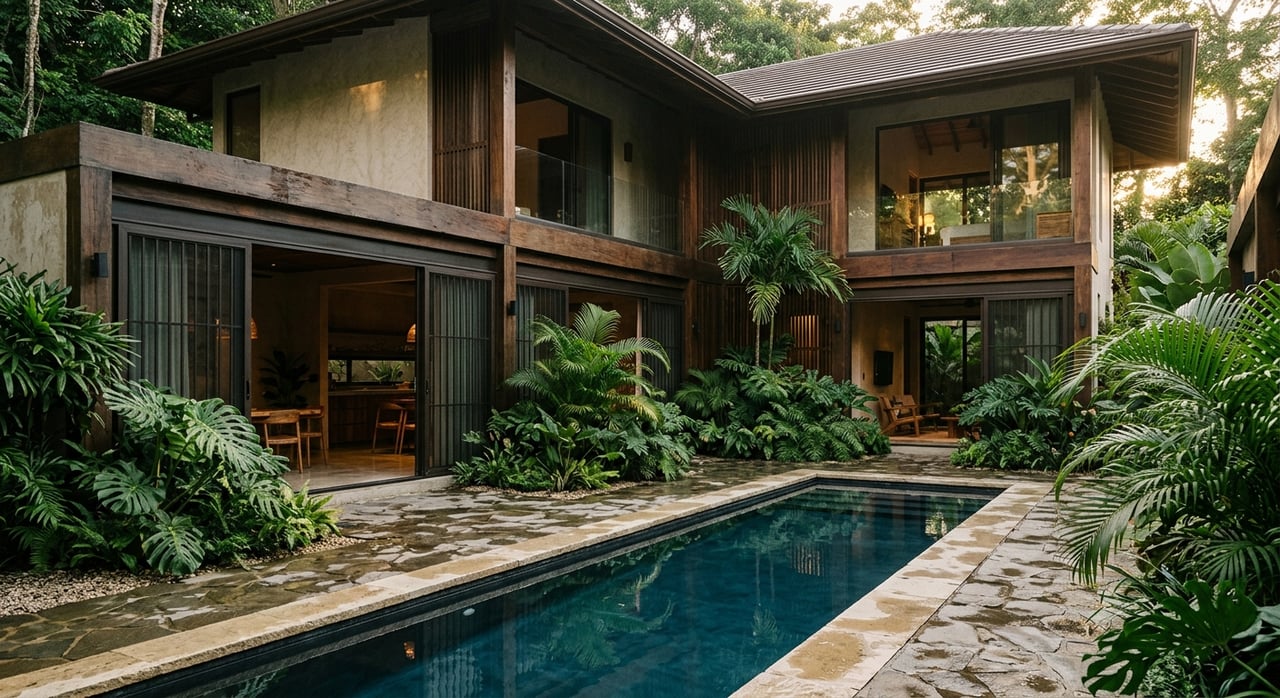
That mix points to a privacy-oriented market with strong demand from couples and small families. In practice, the most investment-friendly product is often a compact, guest-ready home or villa with strong design, clear access, parking, and visual appeal that photographs well for short-stay marketing.
Lifestyle property vs. income property
This is one of the most important distinctions for buyers in Arenal. A lifestyle asset and an investment-grade asset can overlap, but they are not always the same thing.
A larger secluded home, private compound, or scenic lake-view parcel may be perfect if your top priorities are personal use, privacy, and long-term enjoyment. It may still support occasional rental use, but the financial model often looks different from that of a compact villa built around occupancy and guest turnover.
By contrast, a property designed around the tourist use case tends to focus on what guests book quickly: manageable size, efficient layout, strong views, proximity to attractions, and polished presentation. If returns are your main goal, that distinction matters.
Guest demand in Arenal
Arenal attracts a broad mix of travelers, but the rental data and destination profile point to a few especially important segments. Couples are a major fit, especially given the prevalence of 1- and 2-bedroom inventory and the destination’s focus on hot springs, nature, and short stays.
Small families and adventure travelers also fit naturally with the area’s tourism infrastructure. The Northern Zone’s network of trails, hanging bridges, and canopy experiences helps support active itineraries that appeal to visitors looking for a full but relatively short trip.
Wellness-oriented travelers are another relevant segment because La Fortuna is strongly associated with thermal experiences. That creates an interesting edge for homes and boutique hospitality assets that can deliver a peaceful, nature-forward stay rather than simply a place to sleep.
Why eco-tourism creates a different return story
If you are comparing Arenal with coastal markets, the return profile is different. Here, performance is driven less by beachfront scarcity and more by the strength of the experience itself. Visitors come for a dense circuit of attractions that includes volcano views, thermal waters, wildlife, adventure activities, and lake scenery.
That makes design and operations especially important. In an inland eco-tourism market, returns often depend on how well a property fits the destination, how easy it is for guests to use, and how effectively it captures the short-stay traveler’s attention.
There is also a conservation-backed dimension to the story. Because SINAC notes that park entry revenue supports the national parks system, eco-lodges and nature-oriented villas can connect their appeal to a broader protected-area experience. For many buyers, that adds depth to both the ownership story and the guest offering.
A smart way to evaluate Arenal property
If you are considering real estate in San Carlos, start by asking a few simple but important questions:
- Is this property designed for short-stay guest demand or mainly for owner enjoyment?
- Does the location match the experience I want to offer, whether that is convenience, volcano access, hot springs proximity, or scenic privacy?
- Can the property perform through seasonal swings, especially during the rainier months?
- Does the size and layout fit Arenal’s strong demand for private, smaller-format accommodations?
- Will the design photograph and market well to an international audience?
When you answer those questions honestly, the market becomes much easier to read. Arenal rewards alignment. The closer your property matches the way people actually visit La Fortuna and the surrounding area, the stronger your potential position can be.
For buyers looking at premium villas, hospitality assets, or scenic development opportunities in Costa Rica, local insight matters. If you want help evaluating how an Arenal property fits your lifestyle goals or investment strategy, connect with Dawn Wolfe for a more curated, advisor-led conversation.
FAQs
What makes Arenal eco-tourism important for San Carlos real estate?
- Arenal eco-tourism supports real estate demand because La Fortuna draws visitors for volcano views, hot springs, wildlife, nature activities, and lake scenery, creating a broad tourism base that supports multiple property types.
Which Arenal micro-location is most investment-friendly?
- In many cases, the volcano corridor near major attractions and hot springs is one of the most investment-friendly areas, while near-town locations offer convenience and the Lake Arenal side often leans more lifestyle-oriented.
Is La Fortuna property better for short-term rentals or second-home use?
- It depends on the property, but compact, guest-ready villas with strong access and design tend to fit short-term rental demand best, while larger secluded homes and scenic parcels often work better as second homes with occasional rental use.
How should buyers plan for Arenal seasonality?
- Buyers should expect stronger demand in the drier early-year months and softer performance during rainier months such as September and October, then build that seasonality into pricing, owner-use plans, and return expectations.
What guest types drive Arenal rental demand?
- The market appears especially well suited to couples, small families, adventure travelers, and wellness-oriented visitors seeking privacy, nature access, and short experience-driven stays.
What is the difference between an investment-grade Arenal property and a lifestyle property?
- An investment-grade property is usually designed around guest demand, efficiency, and occupancy potential, while a lifestyle property is more likely to prioritize privacy, personal use, and scenic enjoyment even if it also generates some rental income.